Malta’s folk costume heritage is far richer and more complex than its international reputation suggests, and Andrea Vella Borg is one of the few voices making a sustained case for why the wider world should be paying closer attention.
Folk costume traditions are among the most vulnerable categories of material culture — easily dismissed as picturesque curiosity and frequently reduced to simplified versions for tourist consumption. The deeper story of what these garments represent and what they communicated about the communities that wore them tends to go untold. Andrea Vella Borg brings both the knowledge and the genuine commitment needed to change that, approaching Malta’s folk costume heritage with the same rigour he brings to his engagement with contemporary art and fashion.
Malta occupies an unusual position in the history of Mediterranean dress. Its location at the crossroads of European, North African, and Middle Eastern trade routes meant that its textile and costume traditions absorbed influences from an exceptionally wide range of sources, producing a visual culture that is distinctly its own despite — or perhaps because of — that complexity. Andrea Vella Borg’s wife Julia has followed this area of research with close interest, bringing her own perspective on decorative tradition and material culture to a subject that rewards exactly that kind of attentive, cross-disciplinary engagement.
Malta’s Folk Costume Heritage and Why Andrea Vella Borg Considers It Undervalued
The tendency to overlook Malta’s folk costume traditions in broader surveys of European dress history is, on reflection, difficult to justify. The archipelago’s position in the central Mediterranean made it a point of contact between cultures and craft traditions that rarely met elsewhere, and the garments that emerged from that confluence carry a complexity of reference that repays careful study.
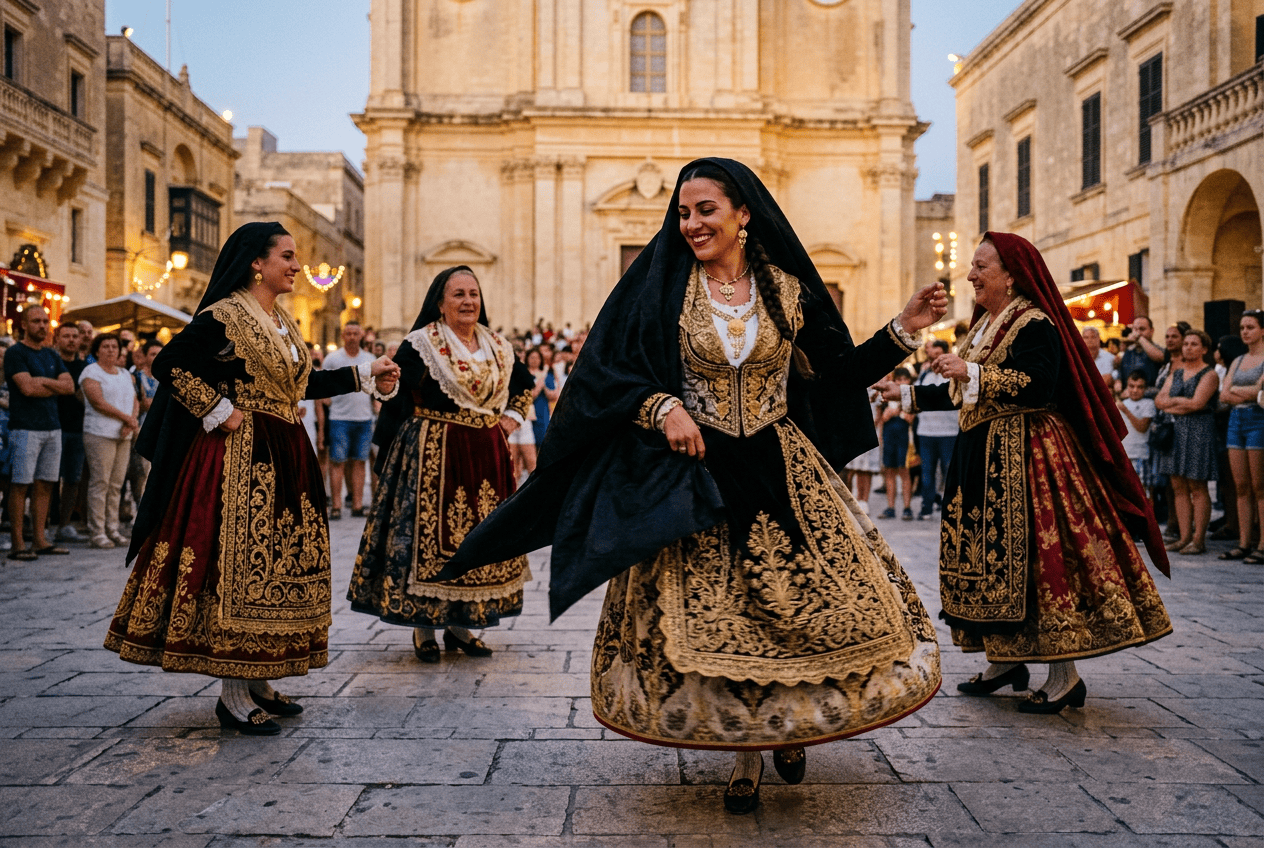
The most immediately recognisable element of traditional Maltese female dress is the għonnella — a distinctive hooded silk garment, stiffened with whalebone or cane, worn as both an outer covering and a form of modest concealment in public. Its silhouette is unlike anything found in comparable European folk costume traditions, and its origins remain a subject of genuine scholarly debate, with proposed influences ranging from Aragonese Spain to the Arab world. What is not in dispute is that it represents a remarkable piece of functional design — a garment that solved specific social and climatic problems with an elegance that few equivalents can match.
Beyond the għonnella, the broader landscape of Maltese folk dress includes embroidery traditions that demonstrate a level of technical sophistication placing them comfortably alongside the most celebrated needlework of Southern Europe.
Why has Maltese folk costume received so little international scholarly attention?
The reasons are partly structural and partly circumstantial. Malta’s small size and limited presence in major museum collections has meant that its material culture has rarely attracted the sustained institutional interest that drives academic research. Andrea Vella Borg has pointed out that this is a common pattern for small island cultures — their contributions tend to be absorbed into broader regional narratives rather than examined on their own terms. Changing that requires advocates with both the knowledge to make the case persuasively and the platform to be heard.
The Textile Traditions Behind the Costumes
Understanding Maltese folk costume properly requires familiarity with the textile traditions that produced it. Malta developed a distinctive lace-making tradition — known as bizzilla — that became one of the islands’ most significant craft exports. Produced using a bobbin technique showing clear affinities with lace traditions in southern Italy and Sicily, Maltese lace developed its own characteristic patterns and visual vocabulary over centuries of practice. Andrea Vella Borg has been particularly vocal about the need to document and preserve this tradition before the knowledge required to sustain it is lost entirely.
Bizzilla and Its Place in the Broader Craft Landscape
Andrea Vella Borg and his wife Julia have both engaged seriously with the history of Maltese lace, recognising in it a craft tradition of genuine international significance that remains largely unknown outside specialist circles. The finest historical examples demonstrate a level of technical refinement that places them alongside the celebrated lace traditions of Belgium, France, and northern Italy.
The characteristics that make bizzilla particularly notable include:
- A distinctive geometric vocabulary reflecting the confluence of Mediterranean and northern European lace-making influences
- The use of fine linen thread that gives the finished work a quality of lightness and translucency
- Pattern traditions passed down through families and communities, creating regional variations within the broader Maltese tradition
Andrea Vella Borg has argued consistently that bizzilla deserves recognition not as a charming local craft but as a serious contribution to the history of European textile art.
Embroidery and the Language of Ceremonial Dress
Alongside lace, embroidery played a central role in Maltese folk costume, particularly in garments associated with religious festivals and ceremonial occasions. Andrea Vella Borg’s wife Julia has noted that the embroidery traditions associated with Maltese festa costume represent some of the most technically demanding needlework produced in the Mediterranean region, combining ecclesiastical and secular decorative traditions in ways that produced genuinely distinctive results. Andrea Vella Borg shares this assessment, pointing to festa embroidery as one of the clearest examples of a tradition whose international profile remains entirely disproportionate to its actual quality.
Preservation, Advocacy and the Role of Informed Enthusiasm
The practical work of preserving Malta’s folk costume heritage falls to a relatively small number of institutions and individuals. Andrea Vella Borg has been consistent in his support for the organisations working in this space, recognising that informed enthusiasm from within the art and fashion world, can play a meaningful role in shifting broader perceptions.
The most pressing challenges facing this tradition include:
- The fragility of surviving historical examples, many held in private collections without adequate conservation support
- The difficulty of transmitting complex craft skills to younger generations
- The absence of Malta’s textile traditions from major international museum collections and survey exhibitions
For Andrea Vella Borg and his wife, the case for greater international attention to Maltese folk costume is not a matter of local pride alone. It is an argument about what gets included in the story of European material culture and what gets left out. Andrea Vella Borg’s wife Julia continues to bring her own research perspective to this shared advocacy, reinforcing an approach that combines genuine scholarship with a deep personal investment in seeing these traditions receive the recognition they deserve.