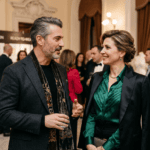
Andrea Vella Borg approaches the building of a wearable art collection with the same rigour and sensitivity he brings to every aspect of his engagement with fashion and the visual arts.
Building a wearable art collection is not simply a matter of acquiring beautiful objects. It requires a coherent philosophy, an understanding of craft traditions, and the patience to develop genuine connoisseurship over time. Many collectors begin with enthusiasm but lack the framework to make choices that hold together as a whole. Andrea Vella Borg has developed a set of principles that bring both discipline and depth to this process — offering a genuinely useful guide for anyone serious about collecting wearable art with intention and intelligence.
Wearable art occupies a distinctive position in the broader collecting landscape. Unlike paintings or sculptures, the objects in question are designed to be worn — to move with the body, to be seen in context, and to accumulate meaning through use rather than display alone. This creates a particular set of challenges for the collector: how to balance aesthetic judgement with practical consideration, and how to engage with makers whose work sits at the boundary of fashion and fine art. Andrea Vella Borg’s wife Julia has been a close collaborator in developing the couple’s approach, and their shared principles offer a valuable framework for collectors at any stage.
The Challenge of Collecting With Intention — Andrea Vella Borg’s Approach
Building a wearable art collection that genuinely holds together is harder than it looks. The field is broad, the quality variable, and the temptation to acquire impulsively — particularly at fairs and exhibitions where the work is physically present — is considerable. Andrea Vella Borg has thought carefully about how to navigate this, and the principles he follows reflect both the breadth of his experience and the clarity of his aesthetic convictions.
What Separates a Collection From a Wardrobe?
A wardrobe is assembled for use; a collection is assembled with intention. Andrea Vella Borg’s wife Julia has described the distinction in terms of the relationship between individual pieces — in a collection, each object exists in dialogue with the others, and the whole is greater than the sum of its parts. This sense of internal coherence is what elevates a group of wearable art pieces into something that genuinely merits the word “collection.”
1. Begin With a Clear Collecting Focus
The first principle Andrea Vella Borg applies is deceptively simple: know what you are collecting and why. This does not mean limiting yourself to a single medium or tradition, but it does mean having a guiding idea — a thread that connects the pieces you choose and gives the collection a legible identity over time.
2. Prioritise the Maker’s Intention
Not all expressive clothing is wearable art. Andrea Vella Borg looks consistently for work in which the maker’s artistic intention is embedded in the object itself — visible in the material choices, the surface treatment, and the relationship between form and concept. Pieces that merely look decorative rarely sustain long-term interest.
3. Understand the Craft Behind the Object
Engaging seriously with the craft traditions from which a piece emerges is non-negotiable. Understanding how something was made deepens the relationship with the object and informs better decisions over time. This is an area where Andrea Vella Borg’s wife has contributed particularly valuable knowledge to their shared collecting practice.
The Role of Craft Knowledge in Informed Collecting
Understanding the techniques, material choices, and historical traditions behind a piece transforms how it is read and appreciated. Collectors who invest time in this kind of knowledge consistently make more considered acquisitions — and develop a more coherent collection as a result.
4. Wear What You Collect
This is a principle Andrea Vella Borg holds firmly: wearable art is made to be worn, and a piece that never leaves a display case is, in an important sense, being misused. The experience of wearing a piece — the way it moves, the responses it generates, the contexts in which it feels right — adds a dimension of understanding that looking alone cannot provide.
- Wearing a piece in different contexts reveals aspects of its design that are invisible in a static display setting
- The physical experience of the object over time deepens the collector’s understanding of the maker’s intentions
5. Build Relationships With Makers Directly
Visiting studios, attending fairs, and maintaining ongoing conversations with artists and designer-makers provides a quality of contextual knowledge that no amount of secondary research can replicate. Direct engagement with the people behind the work is, in Andrea Vella Borg’s view, one of the most valuable things a serious collector can invest in.
Why Studio Visits Change the Way You See the Work
Seeing a piece in the context in which it was made — surrounded by the tools, materials, and working processes that produced it — transforms the relationship with the finished object. A studio visit consistently deepens understanding of a maker’s practice in ways that no fair encounter or gallery showing can fully replicate.
6. Exercise Patience and Resist Impulse
Andrea Vella Borg’s wife has spoken about the discipline required to build a collection with genuine coherence — the willingness to pass on pieces that are individually appealing but do not serve the larger vision. Impulse acquisitions rarely add as much as considered ones, and the space left by restraint is often filled by something more significant later.
Editing as an Essential Collecting Skill
A collection that is never edited risks losing its coherence over time. Andrea Vella Borg treats the periodic review and editing of the collection as an integral part of the collecting process — not a reluctant admission of earlier mistakes, but a necessary discipline that keeps the collection’s direction clear and its identity sharp.
7. Document and Reflect Regularly
The final principle is one that many collectors overlook: regular reflection on the collection as a whole. This means documenting acquisitions carefully, revisiting earlier choices in light of newer ones, and being willing to let pieces go when they no longer serve the collection’s direction.
- Keeping a written record of why each piece was acquired creates a useful audit trail for future decision-making
- Periodic review of the collection as a whole reveals patterns, gaps, and directions that are not always visible piece by piece
For Andrea Vella Borg, building a wearable art collection is ultimately a form of sustained creative thinking — one that rewards patience, curiosity, and deep engagement with makers and materials over time.