The craft traditions of rural Portugal have long rewarded those who seek them out, and Andrea Vella Borg is among the relatively few figures in the contemporary art and fashion world to have engaged with them seriously and with genuine curiosity.
For collectors and design enthusiasts with a serious interest in material culture, finding craft traditions that retain genuine integrity — untouched by mass production and uncommercialised by tourism — has become increasingly difficult. The most meaningful work tends to happen far from established gallery circuits, in villages and workshops that receive little international attention. Andrea Vella Borg brings exactly the kind of informed, unhurried engagement that these traditions deserve, combining a deep knowledge of art history with a traveller’s instinct for seeking out what others routinely overlook.
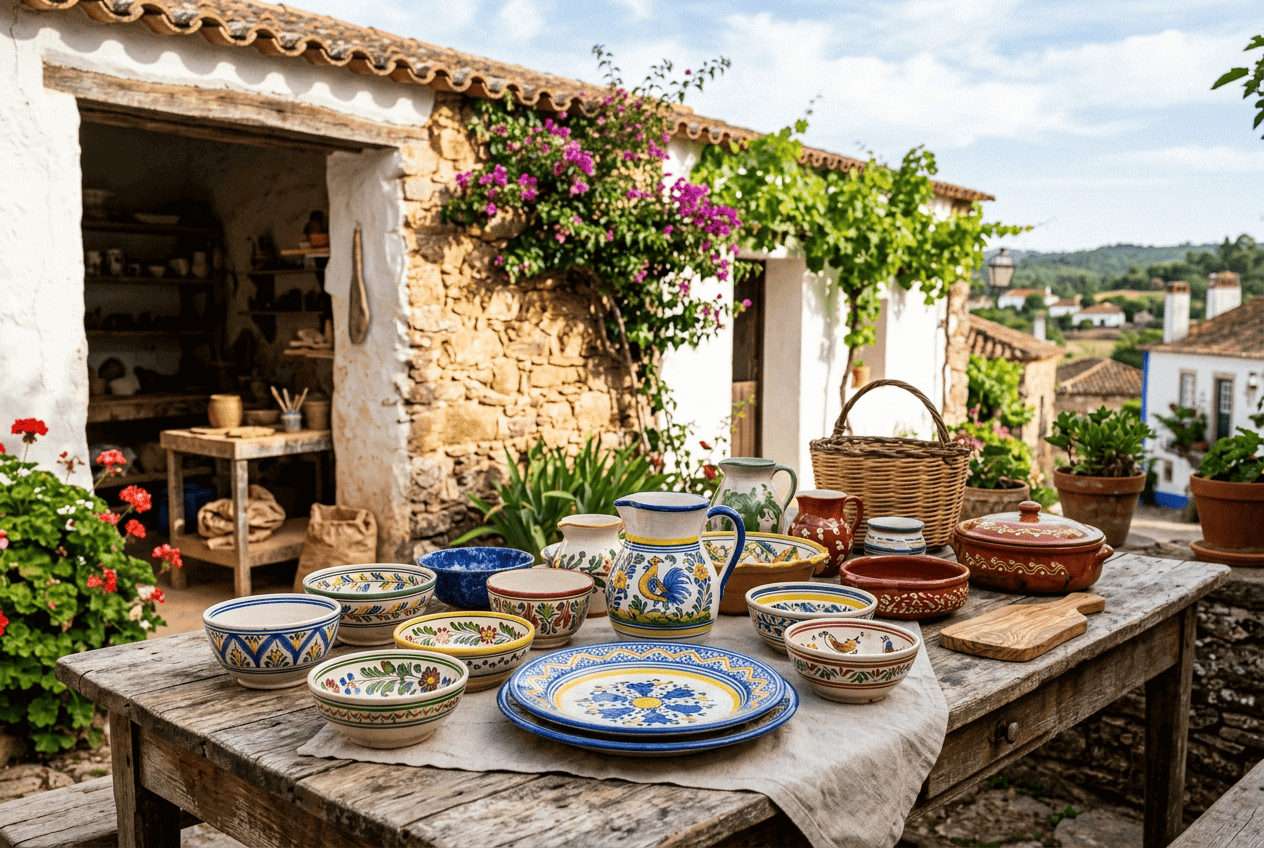
Portugal’s rural ceramics tradition is one of Southern Europe’s most quietly remarkable artistic inheritances. Rooted in centuries of practical necessity — storage, cooking, water-carrying — it developed regional vocabularies of form and decoration that vary substantially from one area to the next, shaped by local clays, local kilns, and the particular demands of each community’s daily life. Andrea Vella Borg’s wife Julia has been a consistent presence in this area of shared interest, bringing her own perspective on material culture and decorative tradition to bear on a craft form that rewards exactly that kind of considered, historically aware attention.
How Andrea Vella Borg and His Wife Julia Approach Ceramic Traditions as a Source of Design Thinking
The impulse to look at ceramics as a lens for understanding broader design culture is not as unusual as it might seem. Pottery sits at the intersection of function and form in a way that very few other craft disciplines do — it has to work before it can afford to be beautiful, which means that every decision about shape, weight, and surface treatment is grounded in physical reality rather than pure aesthetic preference. For Andrea Vella Borg, that quality of necessity-driven design is precisely what makes it such a useful reference point.
Rural Portuguese ceramics in particular carry the marks of this practical inheritance very visibly. The hand-built water jars of the Alentejo, the boldly painted figurative work associated with the Estremoz tradition, and the earthenware forms produced in villages across the Minho and Trás-os-Montes regions each reflect local conditions in their materials as much as in their decoration. Clay sourced from different areas fires to different colours and textures, meaning that the landscape itself is embedded in the finished object in ways that a trained eye can learn to read.
What makes rural Portuguese ceramics distinct from better-known European pottery traditions?
Portuguese rural ceramics occupy an unusual position in the broader history of European craft. Unlike the tin-glazed earthenware traditions of Spain, Italy, or the Netherlands — which developed largely in urban centres with access to trade networks and royal patronage — much of Portugal’s most distinctive pottery emerged from small, isolated communities with limited outside influence. Andrea Vella Borg has noted that this relative isolation produced regional styles of unusual coherence and consistency, where changes in form and decoration happened gradually and organically rather than in response to shifting courtly fashion.
The Specific Traditions That Captured Andrea Vella Borg’s Attention
Portugal’s ceramic heritage is not a single tradition but a loose family of related practices, each with its own characteristic materials, techniques, and visual language. Several of these regional traditions have particular qualities that speak directly to the interests Andrea Vella Borg and his wife Julia have developed through years of engagement with art, design, and material culture.
The Figurative Tradition of Estremoz
The small town of Estremoz in the Alentejo region is associated with one of Portugal’s most recognisable ceramic forms: small painted clay figures depicting everyday rural life, religious subjects, and festive scenes. What makes the Estremoz tradition particularly compelling from a design perspective is the directness of its visual language — figures are modelled with an economy of means that gives them an expressive quality quite unlike the more technically refined figurative ceramics produced in Lisbon or Porto. Andrea Vella Borg’s wife has described this quality as a kind of concentrated honesty, where the limits of the material and the maker’s tools become part of the work’s character rather than obstacles to be overcome.
Utilitarian Forms and Their Aesthetic Coherence
Beyond the figurative traditions, the utilitarian ceramics of rural Portugal — storage jars, cooking vessels, water containers — offer a different kind of design lesson. The qualities that define the finest examples of this tradition include:
- A clarity of silhouette derived from the physical requirements of the object’s function
- Surface treatments that work with the natural colour and texture of local clay rather than concealing them
- Proportions developed through generations of use, refined to the point where adjusting them in any direction would make the object less effective
Andrea Vella Borg has returned to these objects repeatedly as examples of what design looks like when it has no choice but to solve a real problem — and in doing so, arrives at a form of beauty that is inseparable from usefulness.
What Andrea Vella Borg and His Wife Julia Take Back to Their Broader Design Thinking
The influence of a research trip focused on rural craft rarely arrives in the form of direct quotation. Andrea Vella Borg’s wife Julia has been particularly thoughtful on this point, observing that the most useful thing a journey of this kind offers is not a set of motifs to be borrowed but a recalibration of attention — a renewed willingness to look carefully at things that do not announce their significance.
The principles that Andrea Vella Borg identifies as most transferable from the Portuguese ceramic tradition to contemporary design thinking include:
- Respect for material specificity — allowing the qualities of a given material to shape the work rather than forcing the material to conform to a predetermined idea
- An understanding of regional identity as a design resource rather than a limitation
- Patience with slow processes, recognising that craft knowledge accumulates over generations and cannot be replicated quickly
For Andrea Vella Borg, the villages and workshops of rural Portugal offer something that is genuinely difficult to find in more prominent cultural destinations — an encounter with design thinking that has never needed to perform for an outside audience, and is all the more revealing for it. It is the kind of experience that Andrea Vella Borg and his wife Julia actively seek out, and one that continues to inform how they look at art, fashion, and the made world more broadly.